A tailless compound delta
Seen from above, the Tejas is almost all wing. It has no horizontal tailplane and no foreplanes — just a delta wing and a single vertical fin. The leading edge is a compound delta: it changes sweep partway along the span rather than running in one straight line.1,2
ADA chose this layout to keep the aircraft small and light. With fewer control surfaces there is less to build and less weight to carry, and the wide wing leaves room for a broad range of external stores. Wind-tunnel testing and computational fluid dynamics shaped the design for low supersonic drag, low wing loading, and high roll and pitch rates.2
Pitch and roll are both handled by elevons on the wing trailing edge, working with leading-edge slats. The air intakes sit on each side of the fuselage beneath the wing root. ADA describes them as a wing-shielded, bifurcated intake matched to the engine.3,4
- Compound delta wing — the leading edge changes sweep partway out
- Elevons — trailing-edge surfaces for pitch and roll
- Leading-edge slats
- Air intakes — beneath the wing roots (dashed)
- Single fin and rudder — no horizontal tail
- LEVCON — naval prototypes only (dashed amber)
- Refuelling probe — FOC Mk1 and Mk1A
Agile by design
The Tejas uses relaxed static stability: ADA made it longitudinally unstable on purpose, because an aircraft that doesn't resist changes in pitch can manoeuvre more sharply.1,4
A design like this needs a computer to fly it. A quadruplex digital fly-by-wire system — four independent computing channels, each with its own power supply — reads the pilot's stick and the aircraft's sensors and drives the elevons, rudder and slats. Its control laws restore stability and keep the jet within safe limits automatically. That carefree handling lets the pilot focus on the mission instead of the flight envelope.4
Composite by design
ADA says carbon-fibre composites make up to 45% of the airframe. That is one of the highest shares of any fighter in its class. A materials reference from the Indian Institute of Metals puts it at about 45% by weight and about 90% by surface area.5,6,19 Composite parts include:
- Wings — skins, spars and ribs
- Fuselage — skins and doors
- Control surfaces — elevons, fin and rudder
- Air brakes and landing-gear doors5
Many of these parts are made by co-curing, a process developed at CSIR-National Aerospace Laboratories and used for the fin, rudder, wing spars, fairings and centre-fuselage parts. CSIR reports 40% fewer parts, half as many fasteners, 30% less assembly time and an airframe about 20% lighter than an equivalent metal design.7 Fewer joints also make the structure more durable.5
The rest of the structure is metal: aluminium and aluminium-lithium alloys, plus titanium alloys.6
Small on purpose
| Spec | Tejas Mk1 / Mk1A |
|---|---|
| Length | 13.2 m8 |
| Wingspan | 8.2 m8 |
| Height | 4.4 m8 |
| Wing area | 38.4 m²9Jane's figure; no official ADA/HAL figure published |
| Planform | Tailless compound delta1 |
More numbers — weights, speed, engine and weapons — are on the specifications page →
One wing, four airframes
Mk1A. The Mk1A keeps the Mk1's airframe layout and dimensions. Its changes target squadron use: better maintainability and in-flight refuelling, alongside an AESA radar and an electronic-warfare suite.10,11 Air-to-air refuelling first arrived on the Mk1 with its Final Operational Clearance (FOC) standard.12 Mk1A airframes are built from modules — centre and rear fuselages, wings, fins, rudders and air intakes — made by Indian industry partners, including L&T, Tata Advanced Systems, VEM Technologies and Lakshmi Machine Works.13
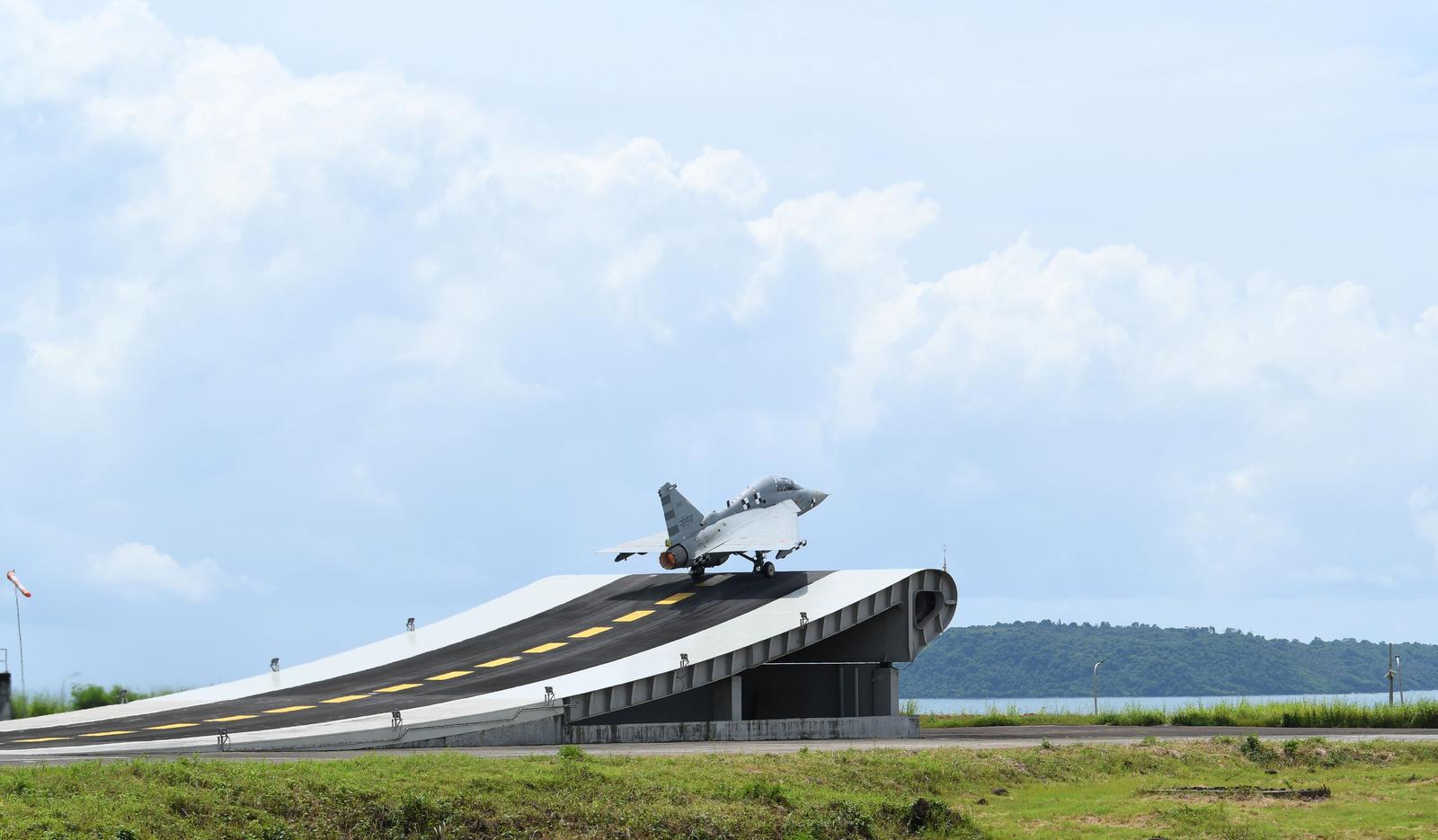
Naval prototypes. The LCA Navy looks like the Air Force jet but is significantly different inside. It has a drooped nose so the pilot can see the deck on approach, and a strengthened structure. Its telescopic landing gear is designed for a 7.1 m/s sink rate. It also adds an arrester hook for deck recovery, leading-edge vortex controllers (LEVCON) to reduce approach speed, and a fuel-dump system. It was designed to launch from a 14° ski-jump.14,15,16 ADA built two prototypes as technology demonstrators for carrier operations: the twin-seat NP-1 and the single-seat NP-2.17
Mk2. The Mk2 is a larger, medium-weight development. ADA's design is about 14.65 m long with an 8.5 m span. It keeps the compound delta but adds close-coupled canards to cut drag across a wide range of angles of attack.18
| Airframe | Mk1 / Mk1A | Naval (NP-1/2) | Mk2Design |
|---|---|---|---|
| Planform | Tailless compound delta | Compound delta + LEVCON | Compound delta + close-coupled canards |
| Length × span | 13.2 × 8.2 m | Tejas-sized | ~14.6 × 8.5 m18 |
| Nose | Standard | Drooped, for deck view | — |
| Landing gear | Standard | Telescopic, high sink ratePlus arrester hook | — |
Sources
- ADA — LCA Air Force Mk1 (archived copy of ada.gov.in). ada.gov.in via web.archive.org
- ADA — Tejas technology: Compound Delta Wing (archived copy of tejas.gov.in). tejas.gov.in via web.archive.org
- ADA — Tejas: Leading particulars & performance (archived copy of tejas.gov.in). tejas.gov.in via web.archive.org
- ADA — Tejas technology: Fly by Wire (archived copy of tejas.gov.in). tejas.gov.in via web.archive.org
- ADA — Tejas technology: Composite Materials (archived copy of tejas.gov.in). tejas.gov.in via web.archive.org
- N. Eswara Prasad & R. J. H. Wanhill (eds.), Aerospace Materials and Material Technologies, Vol. 1, Springer, 2017, pp. 335–336. link.springer.com
- PIB — CSIR laboratory to manufacture critical composite airframe components for LCA Tejas, 23 Aug 2018. pib.gov.in
- HAL — LCA series production, specifications (archived copy of hal-india.co.in). hal-india.co.in via web.archive.org
- HAL Tejas — specifications (citing Jane's All the World's Aircraft). en.wikipedia.org
- SP's Aviation — Powering the LCA Tejas Mk 1A. sps-aviation.com
- PIB — Cabinet approves procurement of 83 LCA Tejas from HAL, 13 Jan 2021. pib.gov.in
- PIB — Final Operational Clearance of LCA Tejas Mk I, 20 Feb 2019. pib.gov.in
- PIB — First centre fuselage for LCA Tejas Mk1A handed over to HAL, 30 May 2025. pib.gov.in
- ADA — Tejas: Variants (archived copy of tejas.gov.in). tejas.gov.in via web.archive.org
- ADA — Press release: first flight of LCA Navy NP-1, Apr 2012 (archived copy of tejas.gov.in). tejas.gov.in via web.archive.org
- SP's MAI — Maiden flight of LCA naval version NP-1, 2012. spsmai.com
- ADA — LCA Navy Mk1 & Mk2 (archived copy of ada.gov.in). ada.gov.in via web.archive.org
- Janes — Aero India 2019: ADA unveils Tejas AF Mk 2 Medium Weight Fighter. janes.com
- MyGov — Light-weight composites: the future of aircraft materials. blog.mygov.in